Your New Video Stalled. What To Check Before You Try To Push It.
A video goes up. The thumbnail is fine, the title is fine, the topic seemed obvious. Twelve hours later the view count has barely moved, and there is a very specific kind of itch that comes with that: the urge to do something, anything, to make the number go up.
I know that itch well. I have been making YouTube content since 2017, mostly faceless channels aimed at viewers in the US, the UK, Germany and Japan, and the single most expensive habit I see in newer creators is reacting to a flat video by pushing traffic at it. This is what to do instead – which starts with understanding what “flat” is actually telling you.
What a stall really is
A new video is tested on a small group before it is shown to anyone else. YouTube watches whether those people click, whether they stay, whether they finish, what they do afterwards. If the answers are good, the group widens. If they are not, the widening stops.
So a stalled video is not a punished video. Nothing has been done to it. It was shown to some people, those people responded in a way that did not justify showing it to more, and the process paused. There is no lock to pick and no switch to flip. There is only a question: which part of it went wrong?
That question has four or five possible answers, and they need completely different fixes. Guessing which one applies is how people end up rewriting a thumbnail that was never the problem.
Read the symptom before you act
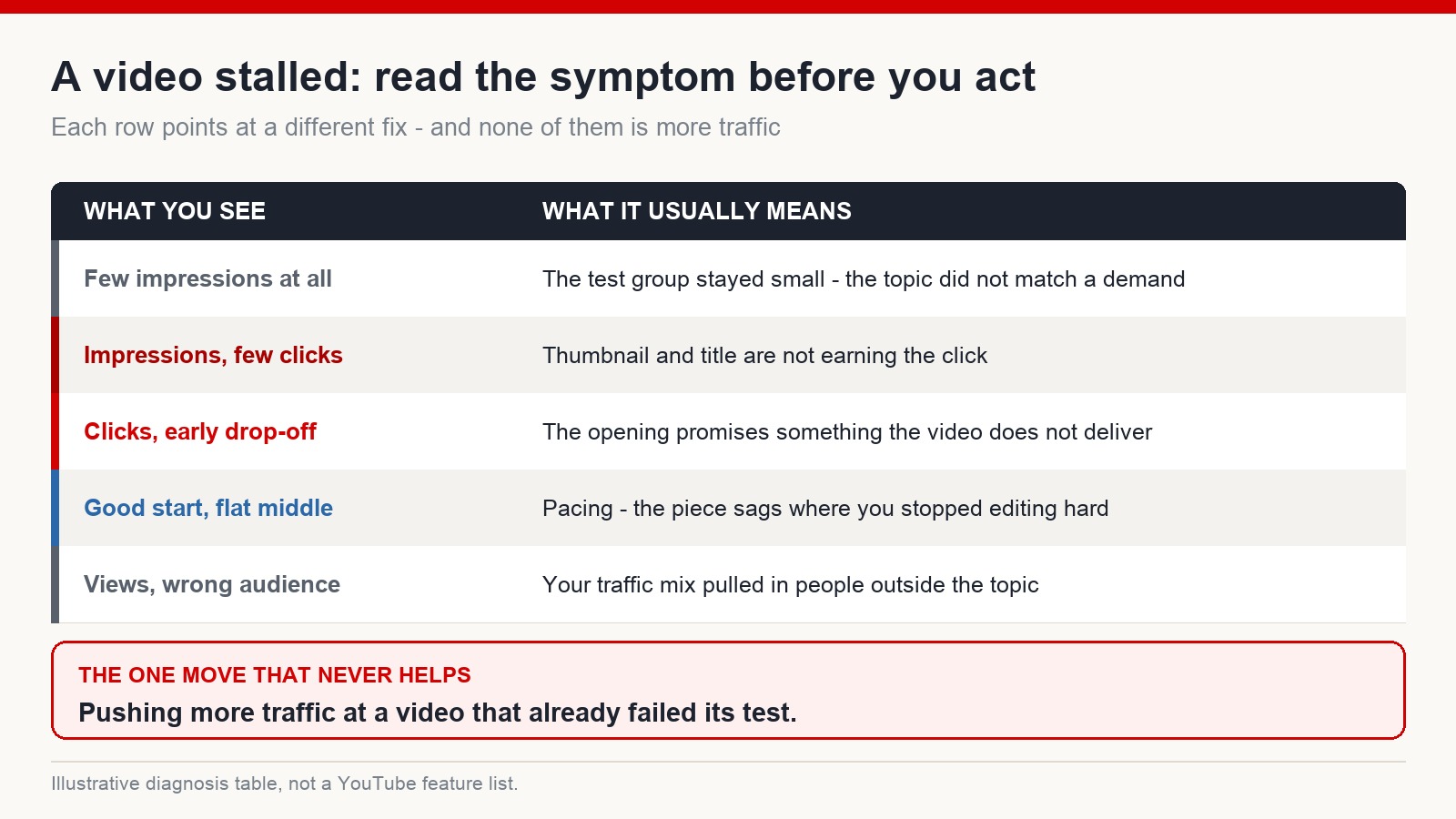
Open the video’s analytics and work down in this order.
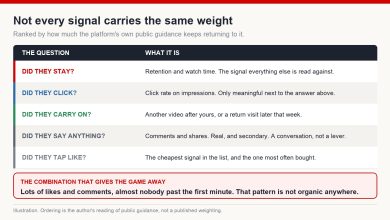
Were there impressions at all? If YouTube barely showed the video to anyone, the click-through rate is close to meaningless – it is calculated on a sample too small to say anything. A very low impression count usually means the topic did not connect to demand that already exists, or the channel does not yet have a track record in that subject.
Were there impressions but few clicks? Then people saw the video and chose something else. That is packaging: the thumbnail, the title, and how the two work together. It is also the cheapest thing on this list to change, because you can change it without re-editing anything.
Did people click and then leave immediately? The opening is not delivering what the packaging promised, or it is taking too long to get to the thing they came for. Watch your own first thirty seconds as a stranger would. Most of the time the problem is a preamble nobody asked for.
Did people stay through the opening and drift out of the middle? That is pacing. Nearly every video I have made sags exactly where I got tired of editing.
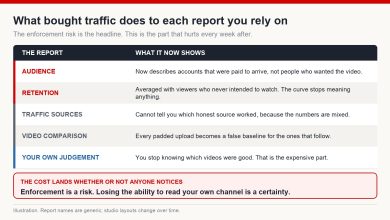
Did views arrive from somewhere odd? If the traffic mix is dominated by external sources and retention from those sources is poor, the audience you brought in was not the audience for the video. That one is worth catching early, because it distorts everything else on the page.
Stop measuring against numbers from the internet
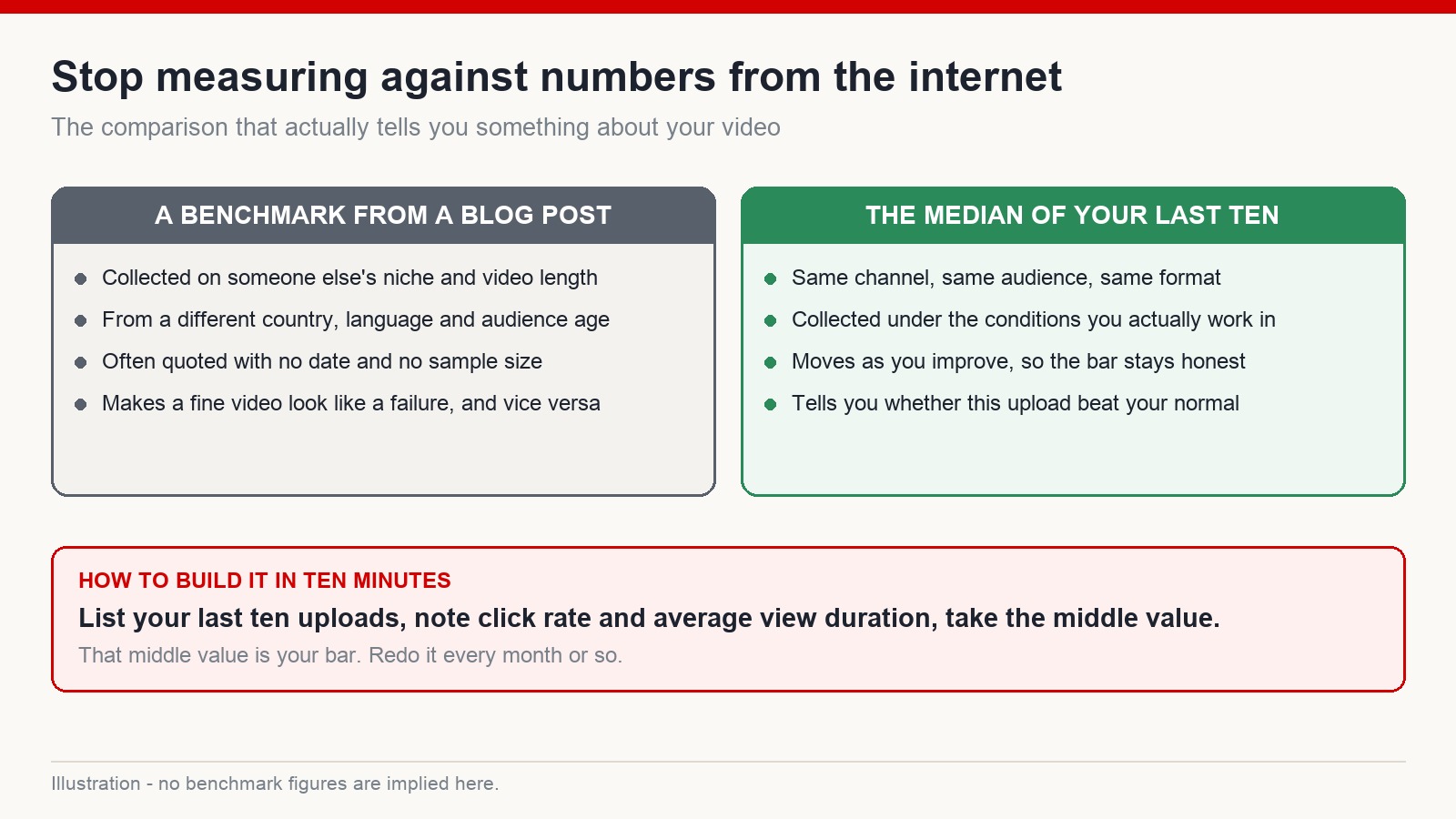
Here is where most diagnoses fall apart. Someone reads that a healthy click-through rate is a particular figure, checks their own, and concludes the video failed – or, worse, concludes it succeeded when it did not.
Those published figures come from other people’s niches, video lengths, languages, countries and audience ages. They are usually quoted with no date and no sample size. Applied to your channel they are close to useless, and they will make a perfectly normal video look like a disaster.
The comparison that works is inward. List your last ten uploads. Note the click-through rate and the average view duration for each. Take the middle value of each column. That median is your bar. It was collected on your channel, under your conditions, with your audience, and it rises as you improve, so it stays honest. Redo it every month or so.
Then the question stops being “is 4% good” and becomes “did this video beat my own normal, and if not, which half of the equation missed” – which is a question you can actually answer.
The fix that is always on offer, and never works
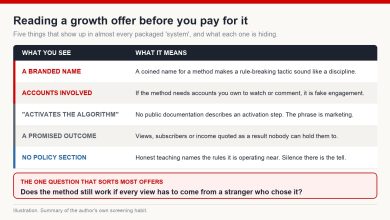
At this point somebody will suggest giving the video a push: a set of separate accounts, each in its own browser profile, on its own connection, used normally for a couple of weeks so they look lived-in, then pointed at the new upload to watch it properly and start a conversation underneath.
It is always presented as the careful, professional option. Not bots. Not bought views. Just a nudge.
It is fake engagement, in full, by YouTube’s own definition. The spam and deceptive practices policy describes fake engagement as views, likes, comments or subscribers that do not come from real people with genuine interest. That definition is about where the interaction came from, not how convincing it looks or how much care went into building the setup. An account you own and operate is not a viewer who chose your video; it is you, wearing a different hat. Bought views, traffic exchanges, view-for-view swaps and comment groups all land in the same place. The documented consequences run in stages: the affected metrics are removed, individual videos come down, and repeat cases end the channel.
The usual objection is that the accounts are isolated well enough not to be linked. Set aside how well platform-scale behavioural analysis actually does at that – it is an argument about detection, and the rule is not “do not get caught.” Separate emails do not manufacture genuine interest. A month of warm-up browsing does not either.
And there is the second argument, which holds even if nothing is ever detected. Your video stalled because the test told you something. Feeding controlled viewers into that test does not fix the video; it destroys the measurement. Afterwards you cannot tell whether the retention curve reflects your audience or your accounts, which means you cannot tell what to change next. You have taken the one instrument you had and broken it, permanently, to make a public number look better for a week.
If you have already done it
Plenty of people find this out after the fact, having been taught the technique as standard practice. The cleanup is unglamorous but short.
Stop using the accounts on your own channel entirely – not gradually, and not “just for the first hour” of the next upload. Remove comments those accounts left, which are the most visible part and the easiest thing to tidy. Expect the affected metrics to be adjusted; that is the system correcting itself, not a new penalty. Do not buy anything from anyone offering to clean, restore or repair a channel, because that market exists to sell a second problem to people who already have one.
Then give it time and treat the next stretch of uploads as your new baseline. The old numbers describe a mixture of real viewers and your own accounts, so they cannot be compared to anything. Build the median of your last ten from clean uploads only, even if that means waiting a couple of months to have ten of them.
What you can legitimately do for an older video
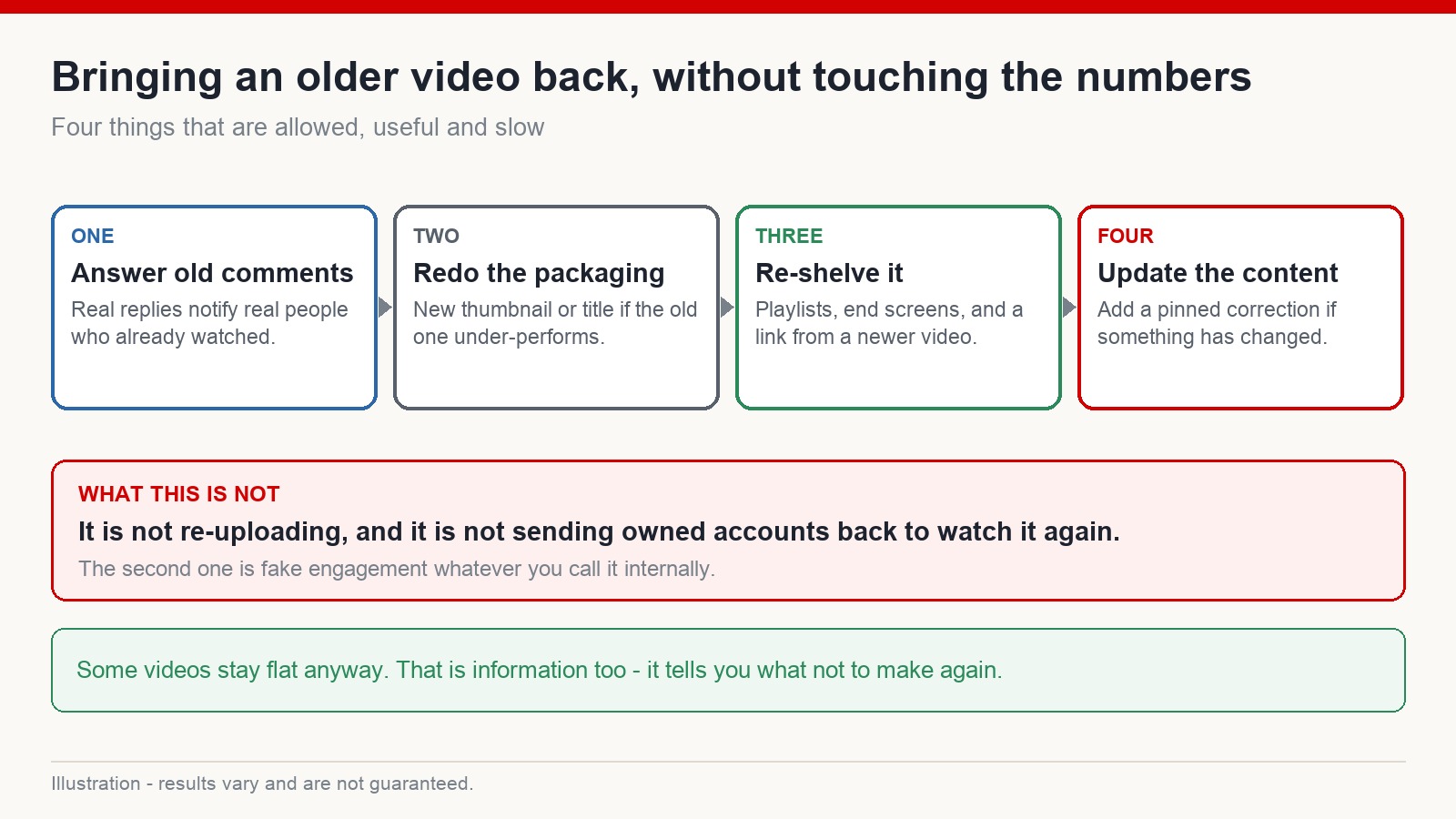
Not every stalled video is finished. There are things that genuinely help, and they are all slow.
Answer the comments, including old ones. A real reply notifies a real person who already watched, and some of them come back. That is not a trick; it is the notification system doing exactly what it is for.
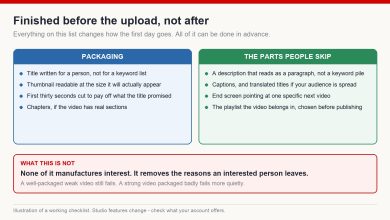
Redo the packaging. If a video has a lot of impressions and a poor click rate compared with your own median, a new thumbnail or a clearer title is the highest-leverage change available, and you can make it in ten minutes without touching the edit.
Re-shelve it. Playlists, end screens on newer videos, a description link where it is genuinely relevant, a pinned comment on a related upload that is still getting traffic. You are putting the video where people who already chose your topic will find it.
Update it. If part of the content has aged badly, a pinned correction is more honest than pretending, and viewers respond well to being told.
What none of this includes is re-uploading the same video hoping for a fresh test, or sending controlled accounts back to watch it again.
When to stop looking and publish the next one
This is the part people skip. A single video is a sample size of one, and channels are not built by rescuing individual uploads. They are built by making the next one better informed than the last.
My own rule is simple: I give a stalled video one honest diagnosis, make at most one change, and then put my attention into the next upload. If three videos in a row show the same symptom, that is a pattern worth acting on properly. One video showing it is noise.
Some videos also just take their time. A piece that answers a search someone makes twice a year does not look like anything for weeks and then quietly accumulates. Panicking on day one and burying it under artificial traffic removes the chance of ever finding that out. Results vary, and nobody can promise you which of your videos will be the slow one.
Questions people ask
How long should I wait before deciding a video failed?
Long enough to have real impressions, and long enough to compare with your own recent uploads rather than with day-one figures. Judging on the first few hours tells you almost nothing.
Will changing the thumbnail reset the video?
No, it does not restart anything. It changes what people see the next time the video is shown, which is the point. Change one element at a time so you can tell what did the work.
Is it worth deleting a video that did badly?
Rarely. Deleting takes the comments and the watch history with it, and a video that underperforms is not dragging your channel down in the way people imagine. Leave it up and learn from it.
Should I re-upload the video to get a second test?
No. You get a duplicate on the channel and no new information. Fix the packaging on the existing upload, or make a better version as a genuinely new video and say so.
My views dropped after I stopped using extra accounts. Is the channel penalised?
More likely you are now seeing the real number for the first time. That is uncomfortable, but it is the number every decision from here should be based on.
The short version
A stalled video is a measurement, not a verdict. Read which part of the test it failed, compare it to your own history instead of someone else’s benchmark, change one thing, and spend the rest of that energy on the next upload. The push everyone recommends does not fix the video. It just makes the instrument lie to you.
If you want the full process for building a faceless channel for an English-speaking audience, that is what we work through at mmoyoutube.com.